


By [Olusegun Ogunkayode—RovroundNews]
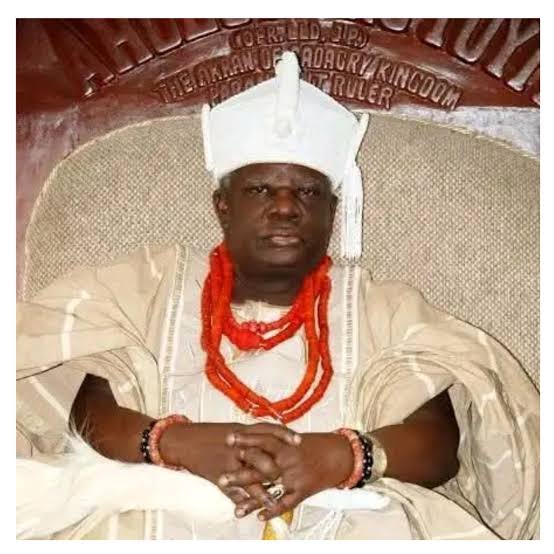
The ancient coastal town of Badagry is in profound mourning as it bids farewell to one of its most distinguished sons and longest-serving monarchs, His Royal Majesty De Wheno Aholu Menu-Toyi I, the Akran of Badagry, who passed away on January 12, 2026, at the age of 89 after a brief illness. His death brings to a close a remarkable reign of nearly 48 years, making him one of Lagos State’s most enduring custodians of tradition, peace and community progress.
De Wheno Aholu Menu-Toyi I, was born on September 18, 1936, into the royal lineage of the Akrans of Badagry. He was the fifth child of his father, De Wheno Aholu Ajiyon-Kanho, a respected ruler in his own right. From his earliest days, Menu-Toyi displayed an exceptional blend of curiosity and discipline, traits that would shape his multifaceted life.
His formative education began at Salvation Army Primary School in Lagos before moving to Methodist School in Badagry. He would later attend Methodist Teachers’ College, Ifaki, Ekiti, where he developed a lifelong passion for learning and leadership.
Before ascending the throne of his forebears, Menu-Toyi dedicated his early professional life to education, teaching in schools across the Badagry Division. His commitment to shaping young minds laid the foundation for a deep connection with his community and a lifelong belief in empowerment through education.
Uncommonly for a future king, he transitioned into journalism, a career that gained national visibility. Beginning at the West African Pilot in 1961 as a diplomatic correspondent and Chief Reporter, he later served as Senior Sub-Editor at the Daily Sketch and then as Acting News Editor (South) with The New Nigeria. His reporting reflected integrity, insight, and a profound concern for national progress.
His excellence in journalism earned him not only respect at home but also an International Press Institute grant him to study at the University of East Africa, where he excelled academically and won a prize in the Law of the Press.
In 1976, after a distinguished career in media and education, Menu-Toyi was selected to succeed his father as the Akran of Badagry. His appointment was formally approved by the Lagos State Executive Council, and on April 23, 1977, he ascended the throne as De Wheno Aholu Menu-Toyi I, the 17th Akran of Badagry.
From the outset, he brought to kingship the values he had cultivated in earlier professions: clear communication, informed dialogue, and community partnership. These traits defined his four-decade plus reign, a reign marked by social cohesion, cultural affirmation and developmental strides.
Oba Menu-Toyi I was widely revered as a father figure whose counsel brought comfort in times of uncertainty and whose presence was a stabilising force for his people. Under his leadership, Badagry, a town globally known for its historical significance as a former slave port and early centre of Western education and Christianity, saw enhanced cultural preservation, tourism promotion and community development.
He understood that traditional leadership must evolve with the times. With that perspective, he worked tirelessly to ensure that Badagry’s cultural festivals, historical sites and community values were celebrated both within Nigeria and on the international stage.
His commitment to national unity and peace was recognised beyond his kingdom. He served as the Permanent Vice-Chairman of the Lagos State Council of Obas and Chiefs, playing a critical role in conflict resolution and collaboration within the traditional institution across the state.
In 1981, the nation honoured his service with the Officer of the Order of the Federal Republic (OFR). He also received honorary degrees, including a Doctor of Laws (LL.D Honoris Causa), in acknowledgment of his influence on socio-cultural progress and education.
Oba Menu-Toyi I’s leadership extended into national platforms where traditional rulers convened to shape discourse on governance, culture and development. In 1990, he was elected by his peers to represent the Lagos State Council of Obas and Chiefs on the National Council of States in Abuja, cementing his influence in national traditional governance.
Among colleagues, he was respected not only for his deep understanding of custom but also for his modern outlook, bridging heritage with contemporary challenges facing Nigeria’s diverse communities.
As tributes continue to pour in following his passing, leaders from all walks of life describe him as a symbol of peace and unity. Former President Olusegun Obasanjo hailed him as an “enduring symbol of unity, peace and inter-ethnic harmony,” while Lagos State Governor Babajide Sanwo-Olu described his departure as “a profound loss” to Badagry, Lagos, and the nation at large.
What sets Oba Menu-Toyi I apart is not merely the length of his reign, nearly half a century, but the quality of his leadership: a blend of wisdom, humility, courage and compassion that touched thousands of lives and strengthened his community’s spirit.
Oba De Wheno Aholu Menu-Toyi I leaves behind a legacy etched in the hearts of his people, one of service before self, tradition hand-in-hand with progress, and unity prevailing over division. As Badagry and the wider Nigerian traditional institution reflect on his life, his story will continue to inspire future generations to cherish heritage while embracing the promise of tomorrow.
May his soul rest in peace, and may his legacy endure.