

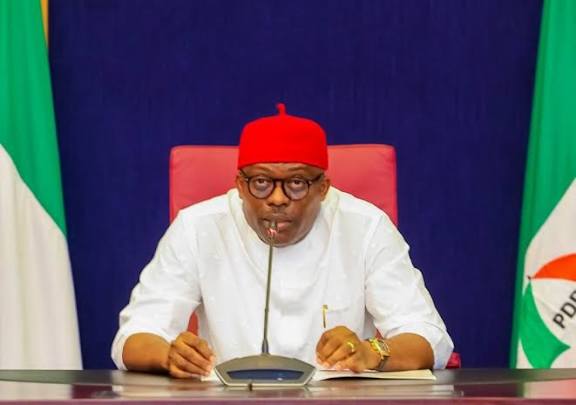

A prominent Niger Delta activist and Ijaw leader, Chief Anabs Sara-Igbe, has declared that the authority of Rivers State Governor, Siminalayi Fubara, is derived solely from the people of the state and not from any presidential appointment.
Sara-Igbe made the assertion during an interview on Symfoni TV, where he stressed that Governor Fubara’s mandate is rooted in constitutional democracy and the will of the electorate.
According to him, the governor was duly elected by the people of Rivers State, and as such, cannot be replaced, overridden, or disregarded by any presidential action.
“The governor’s authority comes from the ballot,” Sara-Igbe said, noting that Nigeria’s democratic structure does not empower the President to nullify the votes of Rivers people by appointing another individual as leader while a constitutionally elected governor remains in office.
He emphasized that Fubara’s legitimacy flows directly from the democratic process and the mandate freely given to him by the electorate.
The Ijaw leader also expressed confidence that Governor Fubara would continue to enjoy strong grassroots support across the state, irrespective of political party affiliations. He said many residents appreciate the governor’s calm and peaceful disposition, describing those qualities as factors that have strengthened his standing among the people.
Sara-Igbe further commended Fubara for what he termed restraint and political maturity in handling the lingering tensions within the state’s political landscape.
He pointed out that although certain executive laws enacted during the administration of former Governor Nyesom Wike could have been invoked against his predecessor, Fubara has chosen not to deploy them.
According to Sara-Igbe, the decision underscores the governor’s commitment to peace, stability, and the avoidance of political confrontation.
The remarks come amid ongoing political developments in Rivers State, where alignments and disagreements within the political class have continued to generate public debate over governance and constitutional authority.